1990s — From Print to Pixel: The Grapevine Goes Online
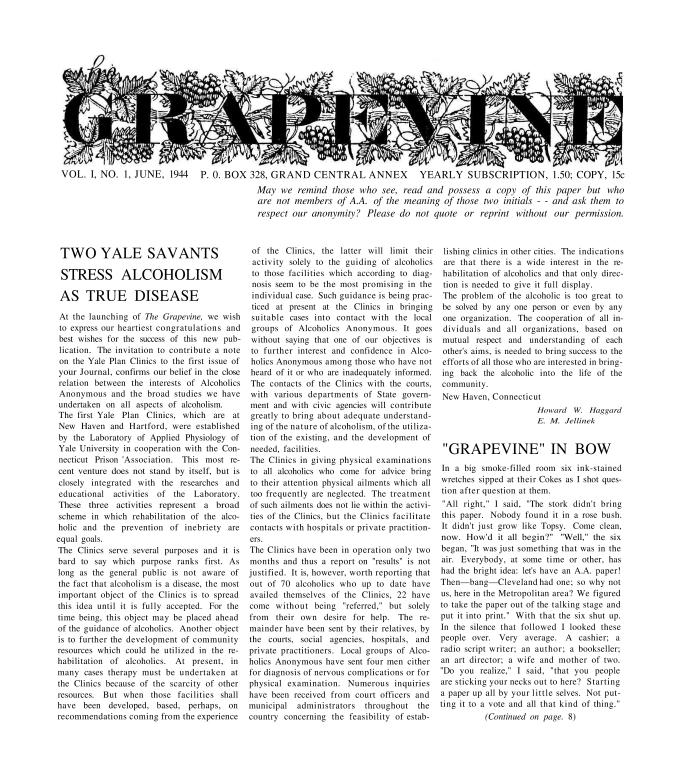
The 1990s transformed Alcoholics Anonymous from a fellowship that met only in church basements into a fellowship that also met in chat rooms. At the start of the decade, the Grapevine was still largely black-and-white, text-dense, and mailed second-class. By the end, it was publishing full-bleed color photographs, running a bulletin board on the early World Wide Web, and debating whether an online meeting could count as a real meeting. These 120 issues capture that pivot in real time — and with it, a profound shift in who AA understood itself to be.
Daily Reflections Becomes AA's Morning Ritual
The most visible literary event was Daily Reflections: A Book of Reflections by AA Members for AA Members, published in 1990. Almost every entry had first appeared in the Grapevine in the late 1980s. Suddenly, the meeting in print was on nightstands across the fellowship. In these issues you will see the source material — short, honest, first-person pieces about resentment, amends, and trudging that editors selected for the daily reader. Circulation of the magazine rose above 140,000 by 1992, the highest since the 1970s, driven in part by groups buying Daily Reflections and then subscribing to its parent magazine. The writing style itself changes: shorter paragraphs, plain talk, less sermonizing. The Grapevine learned to sound like a sponsor, not an essayist.
Grapevine Online and Sobriety in Cyberspace
In late 1991, a few sober drunks on CompuServe and Fidonet started an email list. By 1994, America Online hosted daily AA meetings in a recovery chat room. The June 1994 Grapevine ran the landmark piece “Sobriety in Cyberspace,” where members described dialing in at midnight from isolated farmhouses and logging on from Tokyo hotel rooms. The letters poured in: was this real AA? Could you be anonymous with a screen name? The Grapevine did not resolve the debate, but it documented it faithfully. In 1996 it launched Grapevine Online, a bulletin board where subscribers could read extended versions of stories and post comments — an early precursor to today's comment sections. By 1998, AA World Services had aa.org, and the Grapevine began listing email addresses for intergroups. The last year of this decade, 1999, includes the first mention of “online meetings” as a resource for homebound AAs, foreshadowing what would become essential two decades later.
Full Color, Full Spectrum
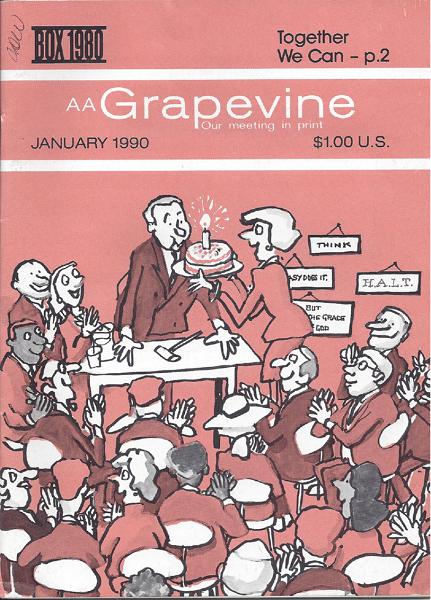
Visually, the decisive moment is mid-1996. Until then, most covers were spot-color illustration — a single PMS color over black line art. Starting in summer 1996, the Grapevine switched to full-color photography and began deliberately reflecting the fellowship’s diversity. You will notice in 1996-1999 a sharp turn away from the generic white family of the 1980s toward Black fathers with daughters, Latina women with 20-year medallions, Indigenous members, and gay couples sober together. Inside, topics once unprintable became regular: women with 20+ years sober, gay and lesbian alcoholics out and sober, HIV and sobriety in almost every issue after 1991, and long, unsentimental accounts of dual addiction, depression, and relapse during the crack epidemic. The language of the heart got wider, and the covers show it.
60 Years in San Diego — 1995
The center of the decade is the 60th Anniversary International Convention in San Diego in June 1995. More than 65,000 AAs from 74 countries flooded Jack Murphy Stadium. The Grapevine published a special convention section in July 1995 — 1995-07 — with panoramic crowd shots, archival speeches, and essays by members who had been at St. Louis in 1955 as teenagers and were now elders. The convention confirmed AA as a global program: Japan sent over 300 members, Poland and Hungary held their first post–Iron Curtain delegations after years of underground meetings. The August 1995 issue carried the theme “The Joy of Living,” a phrase Bill W. used in 1961, now applied to a fellowship that had survived AIDS, the drug war, and its own growing pains. Those bright, celebratory covers are among the most collected today.
What You'll See in These 120 Issues
Browse chronologically and you will see AA learn to live in two worlds at once. 1990-1992 is still the late-80s look: illustrated, muted, stapled. 1993-1995 is transitional: larger headlines, more photographs, desktop publishing replacing paste-up. 1996-1999 is modern: full color, candid photography, URLs at the bottom of the masthead, and inside, honesty about mental health, sexuality, and life on life’s terms that feels contemporary. Search by YYYY-MM — 1995-07 for San Diego, 1994-06 for Sobriety in Cyberspace, 1996-09 for the first full-color photo essay, 1999-12 for millennial reflections where members ask what AA will look like in 2035. Click any cover to enlarge. This is the decade when the Grapevine proved it could be both archive and antenna — preserving 1930s wisdom while tuning in to a future where one alcoholic could reach another through a phone line.