1940s: Birth in Wartime New York
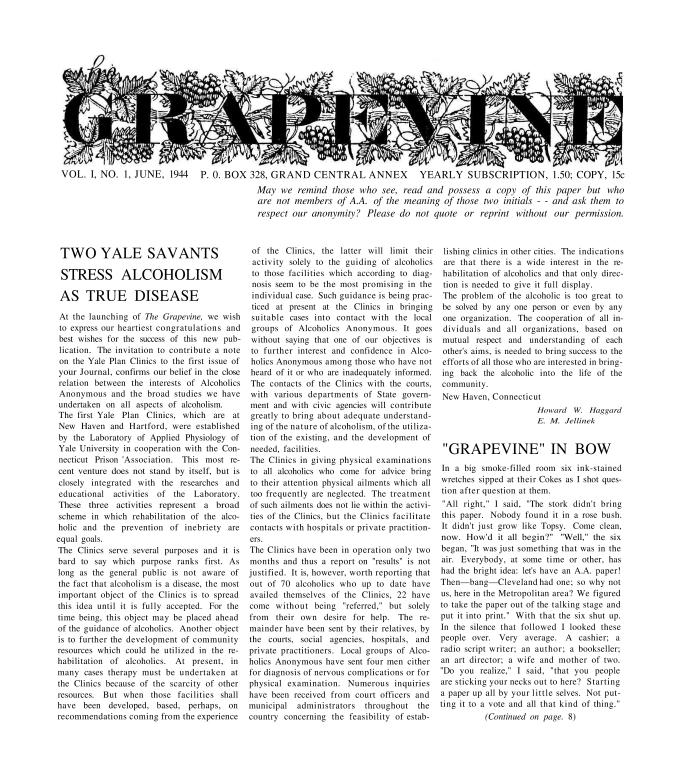
In June 1944, on a paper-rationed, war-weary Manhattan, six AA members gathered in a small office at 30 Vesey Street, two floors above Bill W.’s desk, with a borrowed mimeograph machine, a stack of secondhand stencils, and an idea that felt almost reckless: a monthly meeting in print. The AA Grapevine was born not as a slick magazine but as an 8-page bulletin, typed, cranked, stapled by hand, and mailed to 1,200 subscribers — most of them in the New York area. Bill called it our meeting in print. Lois typed early drafts. Four nonalcoholic secretaries collated pages after hours. There were no photographs, no glossy cover stock, only words, because words were all they could afford and all that mattered.
AA itself in 1944 was still fighting for legitimacy. The Big Book had appeared in 1939 to muted sales. The famous Jack Alexander article in The Saturday Evening Post in March 1941 had triggered an avalanche — membership surged from 2,000 to over 8,000 in a single year — but the Fellowship had no unified service structure, no traditions, no office that could answer the flood of inquiries from ministers, doctors, judges, and wives. The Grapevine became the circuit wire. It carried group news from Cleveland and Houston and Los Angeles, obituaries for early members, and most urgently, letters that the editors titled Mail Call.
Letters From the Front
If you read 1944 and 1945 straight through, you hear another war inside the world war. Mail Call carried V-mail from the Pacific, from North Africa, from troop ships and military hospitals: I’m sober 7 months in this foxhole because old Charlie in Akron wrote me every week. A Navy wife in San Diego wrote that her husband had not had a drink since the Grapevine started arriving at their base. POWs wrote. Nurses wrote. An Army chaplain in England asked for 30 copies to distribute in a stockade. The magazine refused to take a political position — Bill insisted on it — but it became a lifeline for isolated AAs who could not find a meeting within 500 miles.
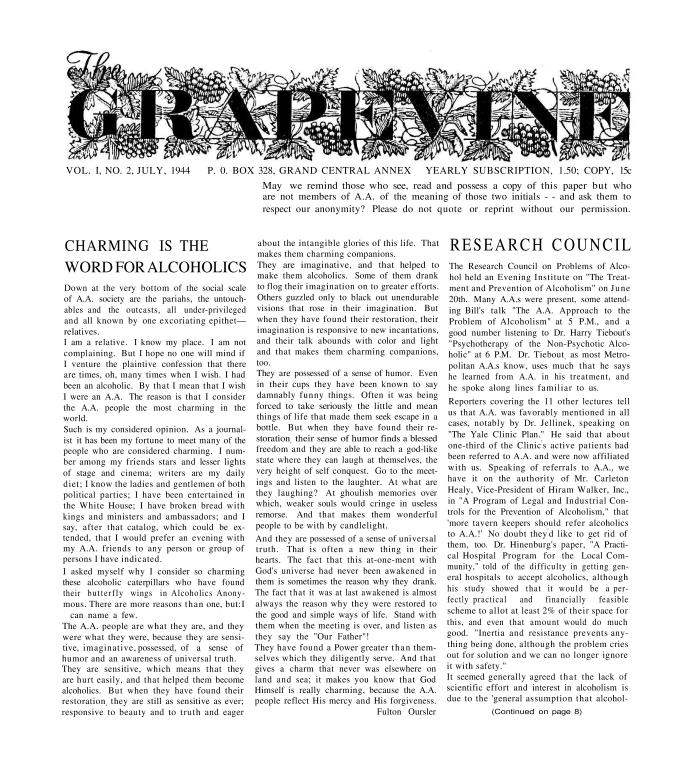
That urgency defined the look of the early issues. Wartime paper rationing meant thin, off-white newsprint. Covers were typographic — bold serif headlines, sometimes a simple woodcut or hand-lettered title — because halftone photos were too expensive and too hard to print on a mimeograph. By late 1945, with offset printing, the magazine added its first line-drawn cartoons, often self-deprecating gags about coffee and ashtrays, and the first regular features that would last 80 years: The Mail Bag, News Circle, and Around AA. Circulation quadrupled to nearly 12,000 by the end of 1945, and for the first time the magazine paid for itself without donations from the Alcoholic Foundation.
The Twelve Traditions Are Born Here
The most important reason historians return to the 1940s is this: the Twelve Traditions were first published here, one per month, as a serial essay by Bill W. In the April 1946 issue, under the title Twelve Points to Assure Our Future, Bill proposed an explicit set of principles to keep groups from destroying themselves as they grew. The essays were tentative, sometimes defensive — Bill answering angry letters from members who thought anonymity was nonsense or that groups should accept outside contributions. Month after month through 1946 and 1947, the debate played out in letters columns: Should an AA group endorse a hospital? Can a member be a paid speaker? What happens when a charismatic founder falls?
Those discussions were later condensed into the short-form Traditions we know today, formally adopted at Cleveland in 1950, but the long form first appeared letter-perfect in the Grapevine, and this archive preserves that original sequence. If you open 1946-06, 1946-08, 1947-01 you see marginal notes, editorial corrections, and early cartoons that show how contentious unity was. Tradition Three — The only requirement for membership is a desire to stop drinking — was Bill’s direct response to letters excluding women, teenagers, and what he called the lower companions. The magazine argued, publicly, that survival depended on radical inclusion.
Dr. Bob, Growth, and the End of the Decade
By 1948 the Grapevine looked almost professional: two-color covers, better paper, a paid editor in chief, and correspondents in Chicago, Los Angeles, and Montreal. Content widened beyond New York. Stories appeared from housewives, doctors, priests, truck drivers — the first attempt to show that alcoholism was not a Bowery problem. In May 1949 Dr. Bob Smith, co-founder, wrote a short, moving piece about his own relapse years earlier and his health, not knowing he had less than a year to live. He died November 16, 1950, but his last message to the Grapevine — Keep It Simple — became the editorial north star.
When the decade closed, the magazine had grown from 8 pages to 48, from 1,200 to more than 26,000 subscribers, from a New York bulletin to an international Fellowship journal. Yet the tone remained intimate, almost handwritten. You can still feel in these early covers that no one was sure AA would last, that this experiment in mutual aid was still fragile, that a meeting in print might be the only meeting some isolated alcoholic would ever have. That fragility is what makes the 1940s collection so moving: it preserves not a triumphant institution but a small, stubborn hope that one drunk talking to another could do what hospitals, churches, and jails could not, even in the middle of a world at war.
What You'll See in This Archive
Mimeographed text covers from June 1944 onward, Mail Call envelopes with APO addresses, the first serialized Twelve Traditions, early cartoons about coffee and cigarettes, memorials for members killed in action, and by 1949, the first photographic covers — still grainy, still earnest — of groups meeting in church basements and living rooms. Search by YYYY-MM, for example 1944-06 for the premiere issue or 1946-04 for the first Traditions essay. Click any image to enlarge to full reading size.